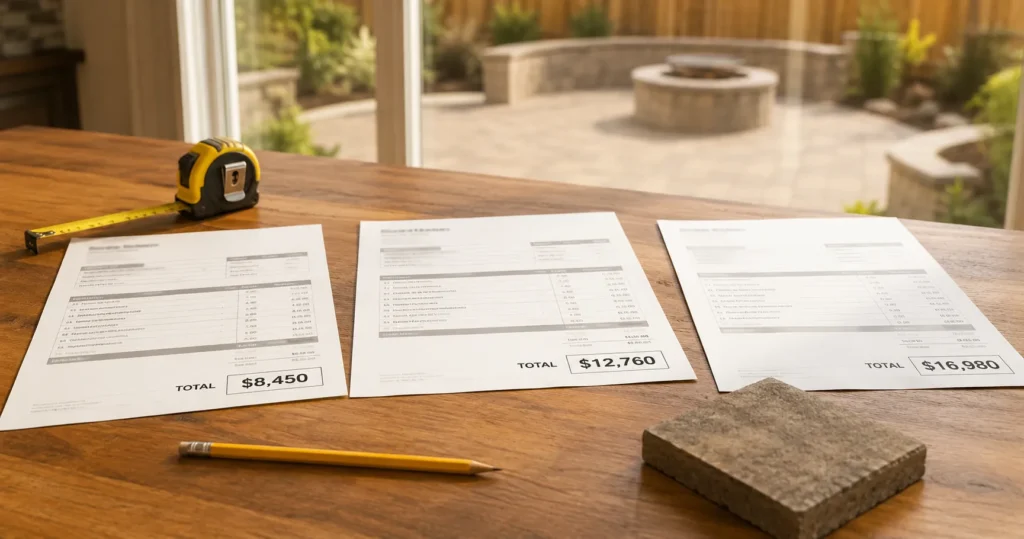
Why do patio quotes vary so much? You describe the same project to three contractors, hand over the same measurements, and receive quotes of $7,500, $11,000, and $19,000. All three sound confident. None of them explain the gap.
Here is the honest answer: those three contractors are not quoting the same patio.
They share a surface area. They use similar words. But underneath the surface — literally — they are describing three completely different levels of engineering, preparation, and long-term performance.
This guide breaks down every reason patio quotes vary, what each price tier actually buys you, when cheap is acceptable and when it is dangerous, and how to evaluate any quote before you sign.
Use the Patio Cost Calculator to get a realistic benchmark before comparing contractor quotes — it gives you a defensible starting number.
Why Do Patio Quotes Vary So Much? The Real Answer
The single biggest driver of price variation in patio quotes is not the surface material you see. It is everything that happens underground before a single paver is laid.
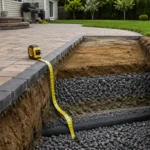
Think of a patio as an iceberg. The surface — concrete, pavers, stone — is the visible tip. The excavation, sub-base, drainage, compaction, and edging sit beneath the waterline. That invisible work can represent up to 50 percent of the total project cost, and it is exactly where budget contractors cut corners to win jobs.
A contractor pricing a basic install designed to last five years quotes a very different number to a contractor pricing a full structural hardscape built to last twenty-five years. Both can truthfully describe the job as “install 300 sq ft patio.” The difference is entirely underground.
What a Cheap Quote Is Actually Missing
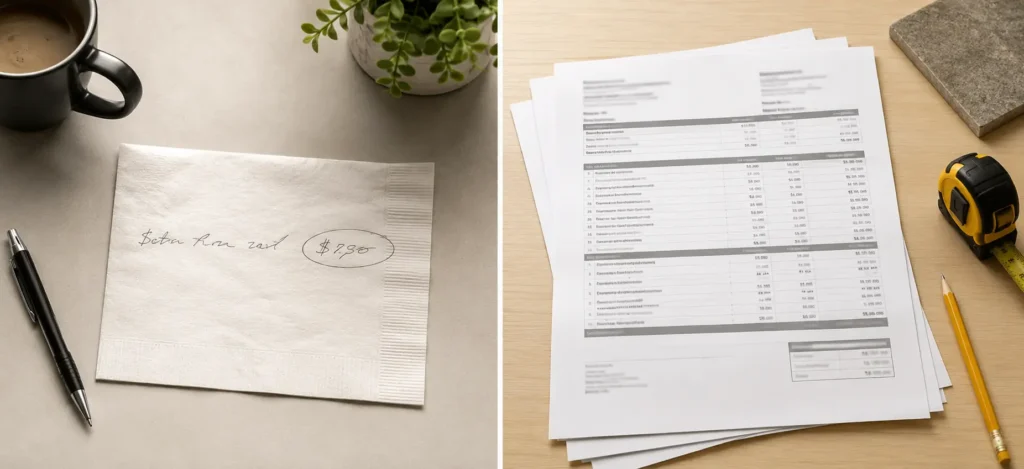
When a quote comes in dramatically lower than others, it is rarely because the contractor is more efficient. It is almost always because something has been removed from scope. Here is what the low bid typically excludes:
Excavation depth — A proper paver patio requires excavating 6 to 8 inches. A budget install digs 2 to 3 inches. The homeowner cannot see this difference until the patio starts sinking 12 to 18 months later.
Sub-base material and compaction — A correctly built patio uses a compacted crushed stone base installed in layers, with mechanical compaction between each layer. A cheap install throws sand down and calls it done. Without a properly compacted base, the patio moves with the ground through seasonal freeze and thaw cycles.
Geotextile fabric — This is the membrane between the soil and the gravel base that prevents the layers from mixing over time. It costs relatively little but is routinely omitted on low-end installs.
Drainage planning — Water must slope away from the house at approximately one-quarter inch per linear foot. A budget contractor lays a flat patio. The first major rainstorm reveals where the water actually goes — sometimes directly toward the foundation.
Edge restraints — Without proper perimeter restraints, paver patios spread outward over time. Edges separate, surface stones shift, and the whole installation gradually loses structural integrity.
Haul-away and disposal — Excavating a 300 square foot patio generates several tonnes of soil. Disposal costs money. Many low quotes leave the soil in a pile in your garden and charge extra to remove it.
Polymeric sand — The jointing material between pavers matters. Basic sand washes out in heavy rain, creating gaps for weeds and insects. Polymeric sand hardens when wet and locks joints in place. It appears in premium quotes and disappears from budget ones.
Here is the real-world consequence of those omissions. A $7,500 quote and a $14,000 quote for the same 300 square foot patio may look comparable on the day of completion. By year two or three, the $7,500 patio is shifting, pooling water, and sprouting weeds. The $14,000 patio looks the same as the day it was built.
The Psychology Behind Price Variation
Price variation is not purely technical. Contractor pricing involves genuine psychology that most homeowners never consider.
The “go away” price — A contractor who is fully booked for the next three months but agrees to quote your job will often price it 30 to 50 percent higher than normal. They do not need the work. If you say yes at that price, it becomes worth disrupting their schedule. If you say no, they have lost nothing. This is a legitimate business practice that generates massive price variation without any difference in quality.
The “survival” price — A newer contractor staring at two weeks of empty schedule and a truck payment due will bid near cost just to keep cash moving. They may do excellent work. They may also cut corners to protect what little margin they have. The low price reflects their business circumstances, not necessarily their quality.
The neighbourhood effect — Some contractors price based on visible wealth signals. A luxury car in the driveway, premium landscaping, or an upscale postcode can shift a quote upward before technical scope is even discussed. This is pricing based on perceived budget, not project requirements.
Volume efficiency — Some contractors build simple rectangular patios repeatedly with highly streamlined processes. Their lower overhead translates to genuine cost savings without compromising quality. This is one scenario where a cheap quote is actually good value.
What the Three Quote Tiers Usually Represent
When you receive quotes that cluster around three price points, here is what they typically represent:
The low bid — Usually an owner-operator or small crew with minimal overhead. No showroom, no office staff, often cash-based. Sometimes excellent value if they are building a reputation. Often dangerous if they are cutting structural corners on base preparation, skipping insurance, or using inadequate compaction equipment. The risk is that you cannot tell which scenario you are in until years later.
The mid-range bid — Typically a licensed, insured hardscape specialist who builds to industry standards. A 6-inch compacted gravel base. Proper drainage slope. Written warranty. This quote usually reflects the genuine market cost of doing the job correctly and legally. It often feels expensive because it honestly represents every step of the work rather than hiding them.
The high bid — A large design-build company with significant overhead: project managers, design staff, branded vehicles, 3D renderings. You are partly paying for the experience and the process, not just the patio. Sometimes justified. Sometimes a premium for extras you do not need.
The smartest comparison is not between total prices. It is between what each quote explicitly includes underground.
Hidden Costs That Blow Budgets After Signing
Even mid-range quotes can generate surprises. The most common cost additions after signing a contract are:
Soil surprises — Old buried concrete, thick clay, unstable fill material, or unexpected tree roots discovered during excavation. These are genuinely unforeseeable and add $500 to $4,000 depending on what is found. A good contractor explains their change-order process upfront. A bad one either discovers these surprises conveniently often or hides the discovery risk in vague contract language.
Scope creep — Once the yard is excavated and homeowners can see the space taking shape, upgrades feel manageable. “Can we just extend it two feet?” adds excavation, gravel, pavers, and labour across the whole extended area. “Can we add a border in a contrasting colour?” requires recalculating the entire layout and additional cutting. Each change seems small individually. Together they can add several thousand pounds or dollars to the final invoice. The grocery cart effect is real in construction — once you have committed to a large project, incremental additions feel psychologically trivial.
Design complexity — A rectangular patio with a straight running-bond pattern installs quickly with minimal waste. Add curves, and every edge stone requires individual cutting. Add a herringbone pattern, and layout time increases significantly. Add multiple elevations with steps, and the project becomes partially structural. Design complexity can double labour costs on an identical square footage.
Access penalties — If a contractor cannot get machinery to your backyard, every tonne of material is wheelbarrowed through manually. This can add $800 to $2,500 in pure labour for a restricted-access site compared to an open one of the same size.
Should You Tell a Contractor Your Budget?
This question divides homeowners. The fear is that revealing a budget number causes contractors to engineer the quote to match it exactly.
That fear is partially legitimate. Some contractors do reverse-engineer pricing toward a stated maximum. The moment you say “we were hoping to stay around $15,000,” an opportunistic contractor knows their ceiling.
But the counterargument is stronger than most homeowners acknowledge. A good contractor uses budget information as a design tool. Without a budget, they may design a project you cannot afford, wasting both their time and yours. With a range, they can suggest realistic materials, flag premium options you may want to skip, and phase the project if necessary.
The practical approach: give a range rather than a hard maximum, and time the disclosure correctly. Let the contractor inspect the site, discuss the scope, and explain their process first. Then share a budget range — say, $12,000 to $15,000 — rather than saying “our absolute maximum is $15,000.” The range protects your ceiling while enabling useful conversation.
The safest phrase is: “We have not fixed a number yet, but we want to understand what is realistic in the mid-range for this kind of project.” That signals seriousness and flexibility without handing over your ceiling.
Does the Time of Year Affect Your Quote?
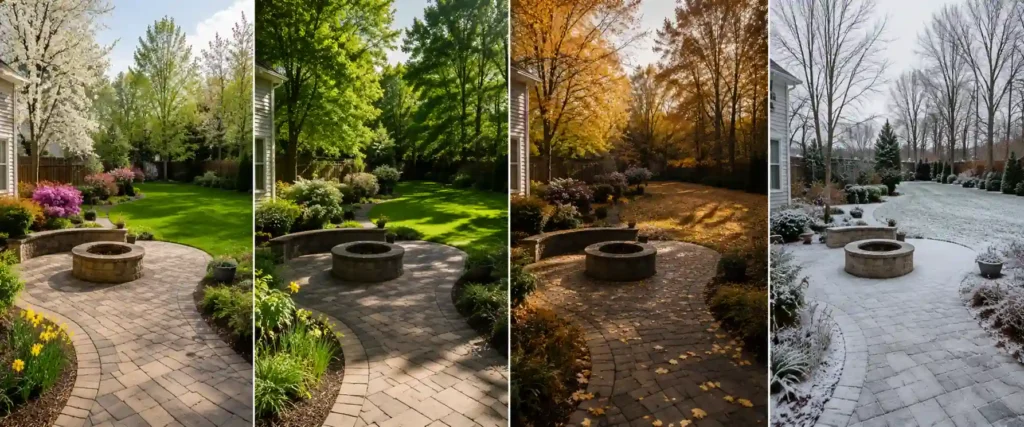
Yes — and significantly. Patio installation is one of the most seasonal trades in home improvement.
Spring is the most expensive season. Every homeowner who wants a patio ready for summer calls contractors in March and April simultaneously. Schedules fill within weeks. Contractors with two-month backlogs have no incentive to discount. Quotes reflect peak demand.
Summer maintains high pricing. Crews are busy. Popular paver products sometimes go out of stock. Extreme heat complicates concrete pours and slows manual work.
Autumn is where many experienced homeowners find the best value. The spring rush has passed. Contractors want to finish the season strong and often have schedule gaps to fill. The weather — cool and dry in most regions — is actually ideal for paving work. Concrete cures well. Compaction is easier. Crews are not rushing between back-to-back jobs. This combination of availability and ideal conditions makes autumn the genuine sweet spot.
Winter produces the lowest quotes in mild climates. A contractor staring at empty weeks will price near cost to keep crews employed. The risk is that frozen or waterlogged ground compromises compaction quality. In cold northern climates, winter installation is not viable. In the southern USA and much of the UK, winter installation is possible but requires careful weather monitoring.
The smartest strategy is to plan and quote in winter, then build in early spring or autumn. Contractors have time during winter to discuss scope in detail, provide accurate estimates, and lock in material prices before spring supplier increases take effect. You secure a better contractor and a better price simultaneously.
Red Flags That Predict a Problem Quote
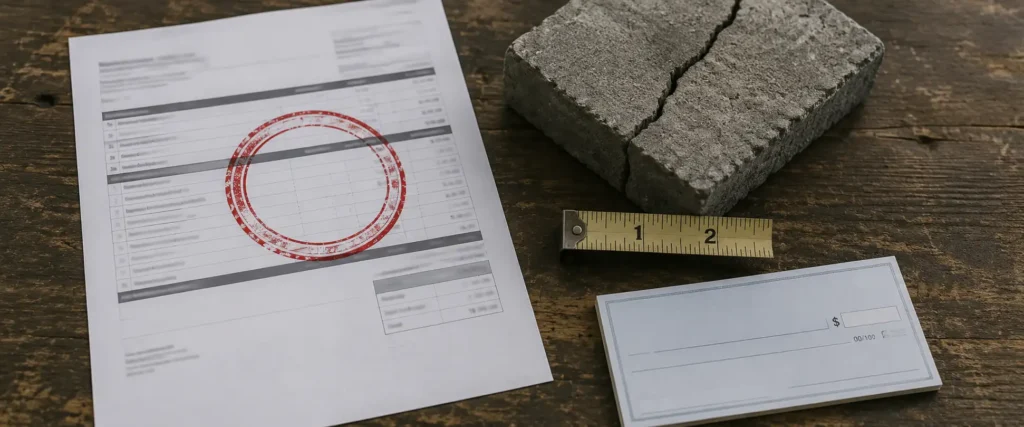
These are the signs in a quote or a contractor interaction that predict either a budget blowout or a disappointing result:
A lump-sum price with no line items — “Build 400 sq ft patio — $9,500” gives you no ability to compare scope, no reference point for change orders, and no accountability if items are omitted. Every legitimate contractor can itemise their quote.
No mention of excavation depth or base thickness — If the quote does not specify how deep they are digging and how thick the compacted base will be, they are not committing to doing it properly. A professional quote specifies these numbers in inches.
No drainage discussion — If a contractor does not mention slope, grade, or water management at any point in the quoting process, they have not engineered the drainage. This is one of the most common sources of long-term patio failure.
An unusually large upfront deposit — A reasonable deposit secures materials and schedule. An unusually large one — particularly with pressure to pay in cash — sometimes indicates cash flow problems or instability in the business.
Instant per-square-foot pricing without a site visit — A contractor who quotes remotely based on square footage has not accounted for your soil conditions, access, drainage, or site-specific requirements. The price means very little without that context.
Dismissing technical questions — A contractor who cannot clearly explain their base preparation process, becomes vague when asked about drainage, or gets defensive when asked for references from older projects is signalling something important.
A Practical Checklist for Evaluating Any Quote
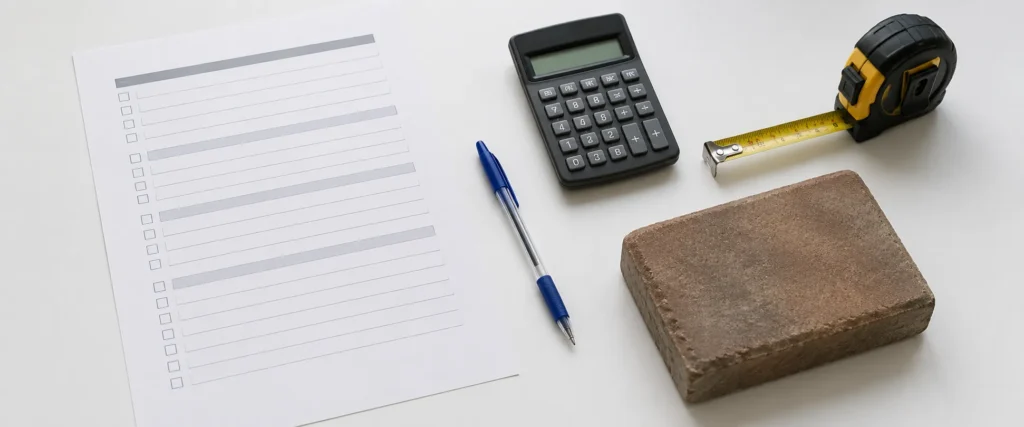
Before signing any patio contract, confirm each of these points in writing:
Structural specifics:
- Excavation depth stated in inches
- Compacted base thickness and material type specified
- Geotextile fabric included
- Edge restraints included
- Polymeric sand for paver joints
Drainage and site:
- Slope direction and degree specified
- Drainage solutions included if required
- Access plan discussed and any penalties identified
Scope and inclusions:
- Soil disposal and haul-away included
- Demolition of existing surface included (if applicable)
- Site restoration and lawn repair included
- Permits — who is responsible
Business and legal:
- Proof of liability insurance available
- Workers’ compensation coverage confirmed
- Written workmanship warranty with specific coverage
- Change-order process defined with written approval required
- Payment schedule milestone-based, not majority upfront
Comparison test: Get a minimum of three quotes. If two quotes are within 10 to 15 percent of each other and one is significantly lower, the outlier is almost never the good deal. Compare what each includes underground, not just the total.
The patio cost per square foot guide breaks down exactly what a proper installation costs at each layer, which gives you a useful frame of reference when reading contractor quotes.
Frequently Asked Questions
Why do patio quotes vary so much between contractors? Because they are usually quoting different levels of underground preparation. The surface material is often similar across quotes. The excavation depth, sub-base thickness, drainage planning, and labour quality vary enormously — and those differences are invisible until years after installation.
Is the cheapest patio quote always bad value? Not always. A low quote can represent a small operator with minimal overhead, a contractor building their portfolio, or a project that genuinely has low complexity. It becomes dangerous when the low price reflects reduced excavation, thinner base material, or missing drainage work. The way to tell the difference is to ask specific technical questions about base depth and drainage. Good low-cost contractors answer clearly. Bad ones stay vague.
Should I tell contractors my budget before getting a quote? Give a range rather than a hard maximum, and do so after the contractor has inspected the site and discussed scope. This enables useful design conversations without handing over your ceiling price.
What is the best time of year to get a patio quote? Autumn for best contractor availability and fair pricing. Winter for lowest prices in mild climates. Spring and summer for worst value — high demand and full schedules mean contractors have less incentive to price competitively.
How do I know if my patio quote is fair? Compare scope, not total price. Ask each contractor to specify excavation depth, base thickness, drainage plan, and material specs. If three quotes cover the same scope and two are within 15 percent of each other, that range reflects the real market rate.
What questions should I ask before signing a patio contract? How deep are you excavating? What base material and thickness? Is drainage included? What brand and specification of paver? Who handles permits? What does the warranty cover specifically? What happens if unexpected site conditions are found?
Summary
Patio quotes vary so much because contractors are rarely quoting the same project. The surface area is identical. The underground engineering is not.
A fair quote is transparent about what sits beneath the surface: excavation depth, base thickness, drainage slope, edge restraints, and disposal. An unfair quote stays vague on those details and competes only on price.
The homeowners who get good patios at fair prices do three things: they get a minimum of three itemised quotes, they ask technical questions about what sits underground, and they compare scope before comparing totals.
Use the free Patio Cost Calculator to build a realistic budget baseline before getting quotes — knowing the real market numbers is the single best defence against both overpricing and dangerous underbidding.
Cost data referenced from Angi and hardscape industry contractor surveys. Prices vary by region, site conditions, and contractor. Always obtain a minimum of three itemised quotes before committing.